Subscribe, Follow & Share!
Apple / YouTube / Spotify
Have you heard the myths about exit planning? Business owners looking to monetize their value in the enterprise long
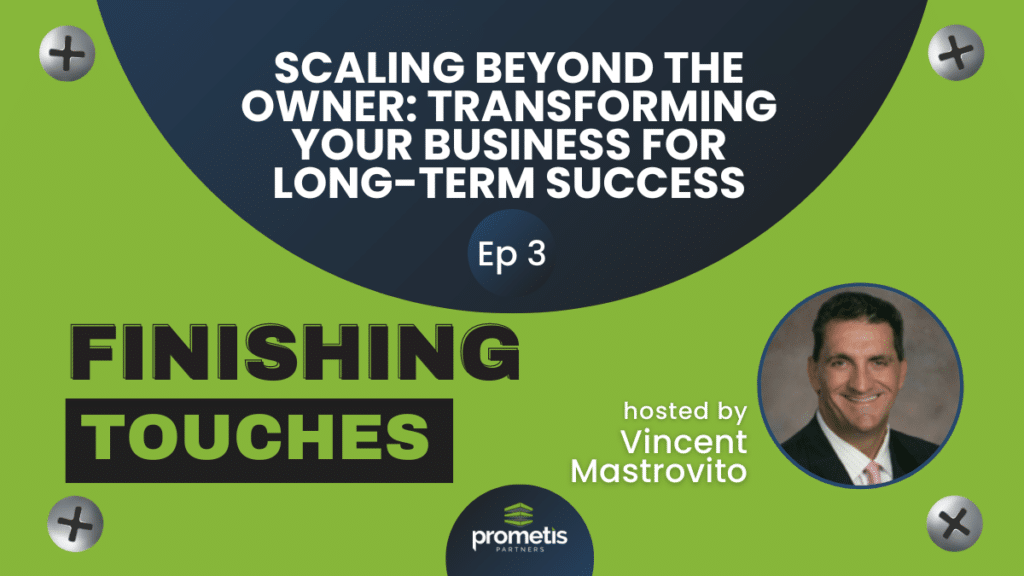
Do you want to streamline your business and increase its productivity? Are you tired of feeling like your business relies too heavily on your presence and decision-making? In this podcast episode, I will unveil the key solution that can help you reduce owner dependency and achieve a more efficient and self-sustaining business. By implementing the strategies and insights shared in this episode, you can experience a significant boost in your business’s autonomy and effectiveness. Say goodbye to the days of being the bottleneck and hello to a business that can thrive even without your constant involvement. Tune in to discover the secret to unlocking a more self-reliant and successful business.
In this episode, you will be able to:
- Unearth the often overlooked impact of owner dependency on the success of your business.
- Delve into actionable strategies for lessening the grip of owner dependency and effectively involving your team.
- Appreciate the fundamental role of delegating tasks and learn why it’s a game changer for your business.
- Adopt a step-by-step approach to enhance your delegation skills and empower your team.
- Understand the art of maintaining consistent oversight and communication while efficiently delegating.
And more!
I’m grateful you’re here, and I look forward to guiding you toward securing your legacy and transitioning smoothly through this podcast. If you enjoy the show, please subscribe and share it with someone you think might also find it beneficial. Thanks so much for listening!
Subscribe, Follow & Share!


Transcript:
00:00:00
Good afternoon and welcome to Finishing Touches, a podcast made by business owners for business owners. And welcome to our next episode of Finishing Touches. Today’s topic is going to be owner dependency. How and why I should change. So many times as we kind of go through our conversations with business owners, what we tend to find is in many companies is that the business is really very centralized around the business owner for various amounts of the day to day tasks, the production of any products and certainly any services that they may provide and certainly a lot of the financials.
00:00:40
So we’re going to get into a statistic here shortly that I ran across a number of years ago. I am sure it has changed, but I thought I would share it with you as a group just to kind of let you know what’s out there and kind of the concern so you can help to kind of evaluate where are you in this process to kind of move through it. So one of the things that we understand here at Prometis Partners is that your business does exist because of your unique talents and skill sets. And I think the key to that is understanding from your perspective as a business owner, what exactly are your talents and skill sets so that you can capitalize on those and maybe hire other key people that have different skill sets that could kind of round out some of the things that need to be done. Now, I understand in the beginning stages of your business, when you started, whether it would be out of your garage, in the basement, working for somebody else, wherever that kind of started, everything kind of evolves over a period of time.
00:01:52
And so we just have to make sure that we’re adjusting and changing and making sure that we’re moving forward. So certainly your skill set got you where you are, your talents got you where you are. And so how do we kind of help move you to whatever that next level is for you or just kind of sustainability, right? Because there’s really three areas that you can really, let’s just call it function as a business owner, right. You could just want to grow your business.
00:02:22
Let’s just grow the business up to a certain level, whatever that number is, and we want to grow the business. The next part is really going to be, well, let’s just make it easier to run, right. So I’ve grown the business to a level and capacity that I feel comfortable. It’s a profitable business. It’s moving forward from a profit perspective.
00:02:40
Now, what we really want to do is I just kind of want to reduce my time in there, right. I don’t need the business as centered around me or you, the business owner, right. And just be able to take more time off, focus on some of your other priorities, your family, your children, whatever else drives you outside of the business, so to speak. Right. I read a study let me just kind of flow over to this study that I read about a while back.
00:03:10
When I read it, I had to go through it a number of times just to kind of grasp it myself was so the US. Census Bureau put out a study a while back. I can’t remember exactly the year, maybe it was 16 or 17. It could have been a little bit earlier, but they stated that their exact numbers 88.6% of US based businesses still require the owner to be there as the primary person that’s responsible for the core functions like producing the production or the product and or the service, depending on whether you’re product or service deliverable and then managing the day to day operations of the financial aspect. So that’s a pretty large number.
00:03:50
I think that might tie in a little bit. As to remember in our previous episode that we talked about in what is exit Planning? In our previous episode is only two out of ten businesses that go up for sale, actually physically sell. And after talking to a number of MNA people and business brokers, investment bankers, I would say that’s kind of in line. That a lot of the reasons why is that the business is very centered around that business owner.
00:04:21
So the business could be very profitable, but if the owner leaves, there’s no way to replicate that value or revenue without him or her there. And so that makes it a bit more of a challenge for someone else or even your children to come in and run the business because it needs you to move that kind of forward. So we have to just make sure we try to keep that in context as we move forward. So I wrote down a question I have in my head that I want to ask all of you to ask yourselves and just maybe write this down. Do a little exercise when you get a few minutes is how much of your business is centered around you and your decision making and how might that be causing any bottlenecks or holding the business back.
00:05:11
So I think if you just kind of step aside and just kind of let’s remove you from the business, pretend you’re not the owner, just kind of sit there and then look at yourself, maybe through a mirror and just kind of say, as I look through this lens, how do I see what I do day to day that might impact the business where it’s too dependent upon me and I’m not leveraging other people. Right. And so that might be a great exercise that you can do fairly quickly. Be honest with it. It doesn’t mean you’re going to jump in and start making massive changes right at first, but I think it certainly gives you a start, gives you a foundation and gives you something to start with as you kind of move forward from there.
00:05:52
So let’s take a look about why or the problem. What can cause this owner dependency or centralization around the owner. When we take a look at a business and let’s just kind of move beyond the beginning stages of the business where it’s obvious that the business owner you the business owner will be fairly involved in the business and functioning day to day just because we got to build up cash flows to get started. So we’ve got a few years in and we’ve kind of moved through. We started hiring some people and we’re just kind of moving down the road.
00:06:24
So what can cause this problem and why? So one thing is control, right? That’s like the number one thing is you as business owners sometimes no matter how passive or aggressive that you are, right? It’s like I got to have control of this business because I need to make sure that it’s going in the right direction. I got to make sure it’s done.
00:06:44
I got to put my hands on it. I got to do it. And so that’s one area that we really need to be cognizant of, right. One of the other ones is going to be lack of financial foresight. So what are we doing financially?
00:06:59
How are we managing the business? Let’s make sure that we’re not running the business to become a lifestyle business, right? Like, oh, hey, we’re going to make enough money so we can pay for stuff over at our house. We know we need to take an income. We’ll chat about that in some different podcasts in the future and we will probably have a guest on there that will interview to kind of go through that because that’s really more of their expertise.
00:07:21
But I think how do you run the do you create budgets? Do you stay to your budgets? Do you do any forecasting understanding what kind of cap intensity you need to do for capex and other things? So how are you managing the finances within the business that could also make sure that you’re not kind of, hey, let somebody else do that piece of it, right? I think another piece is going to be lack of planning.
00:07:46
What is the direction of the company if you don’t know the real direction of the company? And let’s just say we’re just handling business as it comes in, right? And it’s just certainly in today’s environment, it might just be coming in by default. What is the strategic thing that we need to do to make sure, one, this is the right kind of business. We want it’s coming from the right resources, the right profit margins, but certainly the planning piece of that we feel are going to be really important as you move forward.
00:08:13
And then one of the other things is going to be lack of leadership. Do you have leadership that is going to help you move this company forward? Do you have belief in them? And do they have the skill sets and the executable abilities to kind of move forward for what they need to do? And then the last one I kind of made a note on was trust.
00:08:34
It’s like, do you trust the people that you have around you now? To me, this is a bigger issue. If you really don’t have that much trust, then maybe you might want to just think about who do you have in what chair? And it doesn’t mean that this is a bad person. But if you’ve given them a little bit more power than maybe what you want to, or you could trust them to move forward, then either, A have a discussion with them and figure out how to come to some common ground, or B maybe just move into another spot.
00:09:06
Because maybe they’re uncomfortable with that position as it is too. So there’s just a few things to think about from that perspective and what can cause business owner dependency, making sure that that business is really centered around you. You don’t really want to have that happen no matter what the next transition is going to be or what your goal is going to be, right? So let’s talk a little bit about why should we even change it? Right?
00:09:37
So I was at a manufacturing summit a day or so ago down in Traverse City, and Kurt David, who is an Emmy Award winning speaker and author, talked a lot about change. And his focus a lot was like change in leadership or change in you as an owner when you’re transitioning out. But let’s just talk about this type of change, right? And what is change and change? First of all, one of the first things that Kurt David said was change is inevitable.
00:10:08
It is going to happen. Right? If you remember well, this is going way back. If you go back to the 90s, right? We had payphones on the side of corners, in stores, at the airport, et cetera, and now you don’t.
00:10:24
I can’t tell you the last time I have seen a payphone anywhere, right? Because we have cell phones. And then how has the cell phone changed? How has the computer changed? How has the way we’ve even shopped for groceries changed?
00:10:37
So there’s a lot of things that change on a daily basis. We just have to know and how do we accept it? How do we move it forward and make it fit into our lives? Certainly from a business perspective, it’s like, how do we do that inside of a business? So it’s about changing, moving and pivoting and moving it forward.
00:10:53
So let’s just talk about the idea of the business continually being centered around you. I think one of the first main things that I would probably say is that you’re probably holding the business back and it will never reach its full potential one, because you’re just not letting it go. Right. That’s one area that I think if you were going to change and understand is like, hey, I think my business has a lot more potential. Well, we’re going to need to get some other people involved because not one person just can’t do that all by themselves.
00:11:25
There’s just not enough capacity in someone’s space to be able to do that. Right. Next is really less stress. Right. So by giving up control of some of the day to day functions or the production or the financing doesn’t mean you don’t have the pulse on what’s happening.
00:11:40
It just means you’re looking at it from a different perspective and a different level. You still have the pulse on what’s happening inside the company. It’s just that you’re not the one that’s driving each one of those. So that would be some areas to really look at. Another one is that you really start empowering your people.
00:11:57
One thing that we have found in kind of our travels and consulting with business owners is that they have some really good talent around them and it’s really just about, hey, let’s give them that ability to be able to do stuff and let’s make sure that we’re allowing them to grow. Right. Because people come on, they want to contribute, they want to grow. It’s exciting for them and they want to get into that also. So I think those are a couple of things that you really want to kind of keep in front of you and really start to think about.
00:12:28
So let’s kind of go through some of the back part of how do we change, what are some things you can do as a business owner to change? Right. So I think first and foremost, I mentioned part of it earlier is let’s find out what it is that you do well and not well. Right. Are you more in the sales side?
00:12:48
Do you like going out, meeting people? Are you more in operations? Where do you fit? So if you’re in sales, we’re probably not going to be really strong in operations or maybe in some of the other fields. So maybe what you need to do is taking a look, I’m going to stay over here for the time being.
00:13:04
Not that I don’t need to replace myself at some point, but let me get some people over on this side that can really help me finance and operations and marketing and in some of the other areas because I think that will take some of the load, the heavy load off your shoulders. Right. So that’d be one thing. Talk with your team and get some feedback. Tell them what you’re trying to accomplish.
00:13:23
And I think a lot of times when you’re honest with people and you sit down at a table, maybe over lunch or something like that, and you start to have a series of conversation, it might not happen in the first conversation. I think what you need to do is just kind of really talk with them and map it out on a whiteboard and kind of say, hey, look, here’s what I’m looking at doing. Here’s all the things that I think I do, and here’s at least the first number of things I’d like to get off my desk and help empower you guys and gals and help them move forward. Most importantly, these weren’t in any particular order is start slow. So when you give somebody more ability for decision making, execution, do it in a sense, is that you’re kind of managing it for a little while, right?
00:14:06
So one idea might be, hey John, come over here, let me show you how I do this. I want you to start doing this for me. And so you do it so that he sees how you do it and then you have a hey, does that make sense to you? Do you understand how to get that right? Okay, now let’s just reverse it and let’s have John do that for you for a little bit.
00:14:26
And you say, okay, he’s picking that up, he’s doing a pretty good job. And then what you do is you kind of back off of it for a little bit and you say, okay, why don’t you do a few and then come back and get me and let’s take a look at it. And let’s say this happens over a 30 day period of time. Maybe it’s a 60 day period of time, depending on exactly what it is. And then you say, well, John’s got that handled.
00:14:46
He knows what the expectations are, the production, et cetera. So now let’s just kind of let him move. And now you’ve got one thing off your desk. Again, you’re not going to lose what’s happening in there because John’s going to have updates and metrics that he has to report back to you. But I think at the end of the day, what it does allow you to do is it allows you to start getting things off of your desk on a slow basis.
00:15:06
So hopefully that’s helpful. For those of you that watch this podcast, certainly you can take some notes if you would like to ask me any questions. As I’ve mentioned before, you can go onto our website. My email is right there. We do have a chat box right there on our website.
00:15:22
So you feel free to start a chat. It comes right through and I’d be happy to talk to you there. You can go through the LinkedIn if you would like to, or our office phone number is on the website. If you like to just call me and spend five or ten minutes on the phone to talk about it, that would be great too. We’d be willing to answer any questions that you might have that might be helpful for you to kind of help you move through with your business.
00:15:44
So with that said, we’re going to wind it down for this episode of Finishing Touches. We really appreciate you being here today. If you are interested in having a free value gap analysis done for you, it takes about 14 minutes or so to do that. Certainly go to our website or LinkedIn and request a meeting. I’ll send you over my calendar and we can schedule a quick meeting to kind of go through that.
00:16:04
And then we’ll email you over a report and you can kind of read through that and ask any questions beyond that if you might have them from there. So appreciate you being here today. Hope all things go well for you and we’ll see you next time on Finishing Touches. Have a great day.